
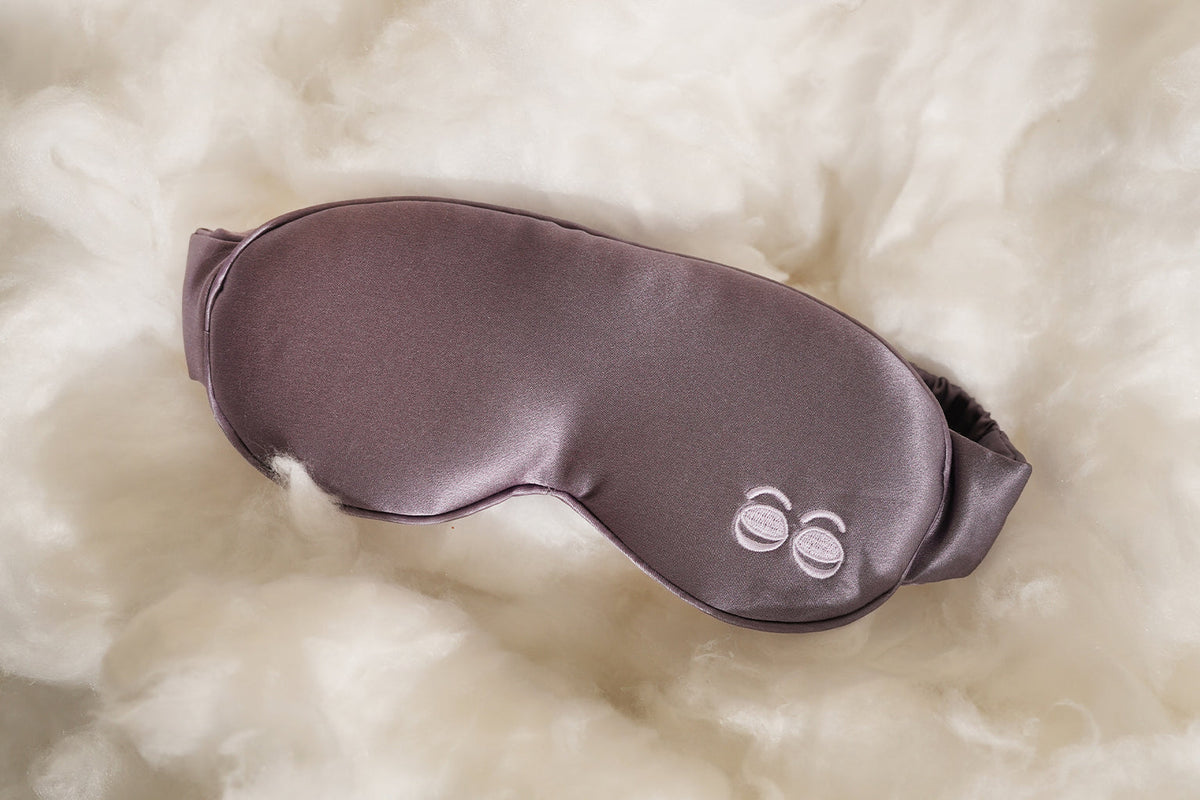
Sleep masks are one of those products where the premise is obvious, and the execution is almost universally poor. The idea is simple: block the light, help you sleep. But the standard flat mask that most people have tried creates a different problem in the process of solving the first one.
Pressure on the eyes during sleep is not a minor inconvenience. It is something that affects your comfort, your lash health, and for some people, their sleep quality directly.
What actually happens with a flat mask
A flat sleep mask rests against the contours of your face. Because eyelids and eye sockets are curved and recessed, a flat surface does not follow that curve. It bridges across and presses down.
For most people, this means the mask is sitting on their eyelids, compressing against their eyeballs, and flattening their lashes against their face for the full duration of sleep. Some pressure may not seem like much, but over several hours, it can make a difference to how comfortable your eyes feel.
People who sleep on their sides notice this more. When your face meets the pillow, the mask pushes inward from one side. The eye underneath takes the weight.
What it does to your lashes
Lashes are easier to damage than most people think. They grow in a specific direction and they hold that direction through the night, depending on what they are pressed against.
A flat mask presses lashes flat. Night after night, this works against the natural curl, and for people who use lash extensions or who are simply protective of their lashes, it is a real problem. The Snoozie's 3D contoured design lifts the silk off your lashes entirely. The fabric touches the brow bone and the cheekbone, not the eye or the lash line.
The pressure and the calm, properly separated
There is a version of eye mask pressure that is intentional and useful. The Snoozie is designed around this: gentle pressure around the eye socket, following the orbital bone, rather than on the eye itself.
This distinction matters. Pressure around the eye area is calming in the same way that Deep Touch Pressure works on the body. It is the same principle behind why a weighted blanket feels grounding. When the pressure follows the shape of the face rather than sitting flatly on top of it, it feels like being held rather than pushed.
The Snoozie's contour cups sit in the space around the eye. The silk hovers above the eyeballs and lashes. You get the pressure signal where it is useful and none where it is not.
Full blackout without the trade-off
Most people try sleep masks for the blackout. And the flat mask does deliver that, at the cost of eye pressure and lash contact. The assumption has been that these are inseparable: want the dark, accept the pressure.
The 3D contoured design solves this. Because the mask lifts away from the eyes, the blackout is achieved by the surrounding structure rather than by the fabric sitting on your eyelids. Light does not get in from the sides because the contour creates a seal against the face. Your eyes are in complete darkness without anything touching them.
For people in India who wake up to early morning light, or who take naps during the day, or who travel across time zones, this is not a small detail. Full blackout signals the brain to continue producing melatonin, which is what keeps you asleep. A mask that is uncomfortable enough to shift during the night breaks that signal.
The strap problem
One more thing flat masks get wrong: the strap. Standard elastic loops dig into the back of the head after a few hours. They also pull at hair, particularly for people who sleep with their hair up.
Snoozie uses a silk scrunchie strap. No hard elastic edge. It holds the mask in place without creating a pressure point at the back of the head, and it does not snag or pull at hair when you remove it. For side sleepers especially, this matters, because the strap is what stays in contact with the pillow.
Available in Dawn (warm golden beige) and Dusk (deep mauve purple).
|
A sleep mask that actually fits your face — shop Snoozie at doozielife.com |


Share:
What 22 Momme Actually Means (And Why Most Silk Masks Don't Say)
Can a Silk Eye Mask Really Make a Difference to Your Skin?